 |
| We know the chemicals in the cleaner are dangerous. But what about the ones on the plastic itself? Image found at mommybrainreports.com |
As with all things, there are pros and cons to changing current regulation standards. A definite positive would be stricter guidelines and more assurance that we, the consumers of the products, are safe from being exposed to toxic chemicals. A more standardized system would make sure we aren't playing a game of Russian roulette when buying products regulated by different agencies but containing the same chemicals. A severe downside of this would be the sheer cost of time and money it would take to both implement and carry out these new regulations. In an already broken economy such regulation reform could cause the country even more economic hardship. Furthermore, enforced use of different chemicals could result in inferior products.
I was mostly interested in the chemical formerly used in producing plastics: BPA or bisphenol A. There were five levels of concern in regards to exposure to this chemical as outlined by the National Toxicology Program, and frankly, the definitions were downright shocking and kind of nauseating. "Reproductive toxicity in adult men and women and malformation is newborns" was defined as "Negligible Concern." "Developmental toxicity for fetuses, infants, and children (effects on the mammary gland and early puberty in females, and productive toxicity in workers)" was defined as "Minimal Concern". And "Developmental toxicity for fetuses, infants, and children (effects on the brain, behavior, and prostate gland)" was classified as "Some Concern". Very fortunately, many large companies such as Target, Wal-Mart, Costco, and REI have stopped selling products containing BPA and found safer substitutes that sell just as well.
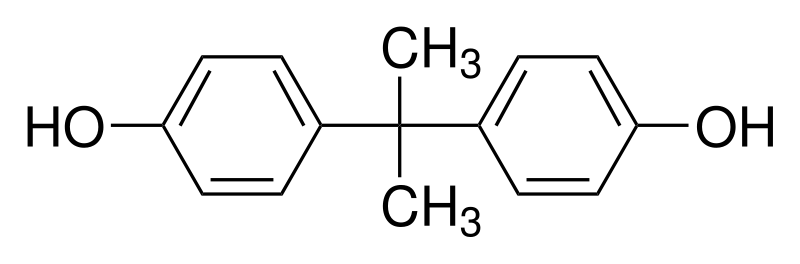 |
| This is a representation of the chemical structure of Bisphenol A. Image found at viewzone.com |
For further research on BPA, I went to these two websites:
http://www.bisphenol-a.org/about/faq.html?gclid=CIzx3KT-9K8CFWQ0QgodCEP3RQ
http://www.fda.gov/newsevents/publichealthfocus/ucm064437.html
At the first website, I learned that BPA is used primarily to make polycarbonate plastic and epoxy resins. The products made from BPA's byproducts are things such as electrical and electronic equipment (like CDs and DVDs), automobiles, sports safety equipment, reusable food and drink containers - products most of us use on a daily basis. This website declares that, and I quote, "the weight of scientific evidence clearly supports the safety of BPA and provides strong reassurance that there is no basis for human health concerns from exposure to BPA."
 |
| Are these bottles safe for your child? I don't know either. Image found at diapersect.com |
After reading this article, I firmly believe we should use the precautionary principle approach when regulating chemicals in the country. It may cost more, but I believe human lives should be protected.

In the US, I think we are too used to react to problems than being proactive to prevent problems. As the FDA starts to increase concern for BPA exposure, I believe the FDA is still not being active enough against the chemical usage because they are so tied to strong scientific proof.
ReplyDelete