Tuesday, May 15, 2012

It's Gettin' Hot in Here

Here, meaning the planet Earth.  This week's blog is devoted to some research about climate change.  Climate change, as the name suggests, is a significant, lasting change in the Earth's current norm of distribution of weather patterns.  These periods of change can last anywhere from decades to millions of years.

This little baby is losing his habitat.
photo found at blogspot.com
According to the United Nations Climate Change Information Kit (UNCCIK), the Earth's climate is indeed changing right now, and the Earth is growing hotter.  The UNCCIK claims that the rate of the Earth's warming in the 20th Century (1900s) was the greatest it's been in the last 1,000 years.  They say that the average global temperature has increased by 0.6 degrees Celsius, +/- 0.2 degrees.  This rising temperatures have a very strong possibility of contributing to rising sea levels as well.  Furthermore, snow cover has declined 10% since the 1960s in the Northern Hemisphere.  Artic sea-ice now decreases by 10-15% in the summer and thinned by 40% in the summer to early autumn.  This habitat degradation affects all the animals that live there, including polar bears.

Now why do these statistics about climate change matter?  Isn't this a natural process the earth goes through?  Simple answer: yes.  The Earth does have periods where it heats up and cools down naturally, for example: the ice age.  However, humans are affecting this natural process now, messing with the Earth's natural heating and cooling cycles.

So, how do humans affect climate change?

Human activities release greenhouse gases into the atmosphere, and these gases control how natural energy flows through the climate system.  The increase in greenhouse gases interferes with the process of the sun providing energy to the Earth, and the Earth releasing energy back into space.  So, the Earth has to raise its global temperature to adjust to the "thicker blanket" of greenhouse gases to properly maintain the flow of energy to and from the Earth.

The use of these affects the Earth more than we think.
photo found at freefoto.com
This term "greenhouse gasses", what does it mean?

A greenhouse gas is a gas in the atmosphere that emits and absorbs energy through the thermal infrared range and help regulate the natural energy flow.  Greenhouse gases are things like carbon-dioxide (which is released when burning fossil fuels and when forests are burned down) and methane & nitrous oxide (which is released during agricultural activities).  Since humans rely so heavily on current agricultural methods to feed people and the burning of fossil fuels to provide energy, a ton of extra greenhouse gas is added daily to atmosphere.

So, why does this matter to humans?  How is this going to affect us?

For one, there are food security and agricultural risks to consider.  Certain areas will no longer be able to produce the same amount, type, or any crops if the climate changes too much.  This increases the already horrible economic strain on countries who can't feed their people, and it puts people in affluent societies at risk of going hungry as well.  Furthermore, with rising sea levels, we lose coastal areas of land where people live or visit for recreational purposes.  More humans will move inland, meaning less space for people overall, and the low-income nations whose national wealth rely heavily on income provided by tourists will suffer greatly.
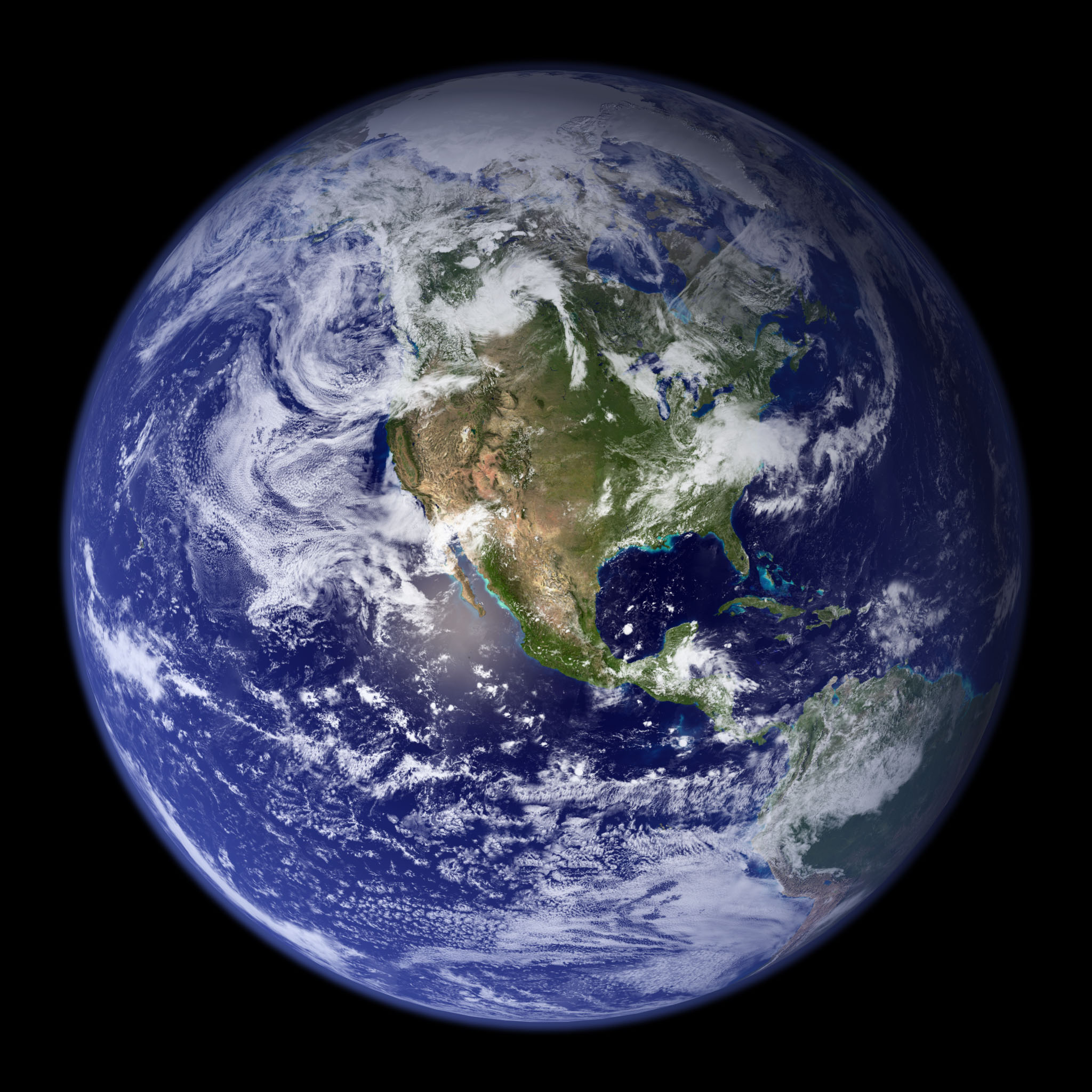
The Earth warms and cools on its own.  As of now, we
don't know how much human activity affects this process,
says the global warming skeptics.
photo found at nasa.gov

Now, it behooves me to address the opposition as well.  There is much skepticism surrounding global warming, and most of it centers around the fact there is no overwhelming consensus on whether global warming is really a crisis.  Many argue that scientists don't understand the Earth's cooling and heating process nearly well enough to predict what will happen in the future.  Furthermore, we don't know exactly which percent of the Earth's warming is caused by human activities.  One of the biggest reasons implied in the hearland.org article that the skeptics hold so tightly to their arguments is the sheer cost of implementing change and preventative measures.  It would increase taxes and call for more government control over the disbursement of money.  So, people are worried about it costing both money and freedom.

Given what I learned, I believe that should humans continue using fossil fuels with no thought to the environment, the Earth will be a much, much hotter place in 50 years.   The farming and agricultural industries we rely so heavily upon will produce much less than what is needed to feed the world, and only the humans who can adapt to the harsher conditions will continue on.  Basically, humanity is greenhouse-gasing itself into an earlier cycle of natural selection.  Like Charles Darwin wrote, those best suited to living in the environment will survive.

Wednesday, May 9, 2012

Chemically at Risk

We know the chemicals in the cleaner
are dangerous.  But what about the ones
on the plastic itself?
Image found at mommybrainreports.com
Today, I read the article "Reducing Toxic Chemicals: Do We Know Enough About Chemical Risk?".  I was surprised by how much I didn't actually know.  As mentioned in the article, I assumed that the products I bought at stores and such were regulated by the government to be as safe as they could for human use.  Be it the chemicals in cleaners with proper warning labels to the plastics used in my reusable water bottles, I thought all of it was regulated by the same standards.  This is not true.  Different agencies of the government adopt different levels of acceptable risk for the same chemicals.  Many scientists and activists are arguing that the government should impose laws that will standardize the regulation and adopt the precautionary principle of making a significant effort in researching the safety of a chemical before allowing human contact.  This is different from the current system in which a product must be proven dangerous before it will be pulled off the shelves.

As with all things, there are pros and cons to changing current regulation standards.  A definite positive would be stricter guidelines and more assurance that we, the consumers of the products, are safe from being exposed to toxic chemicals.  A more standardized system would make sure we aren't playing a game of Russian roulette when buying products regulated by different agencies but containing the same chemicals.  A severe downside of this would be the sheer cost of time and money it would take to both implement and carry out these new regulations.  In an already broken economy such regulation reform could cause the country even more economic hardship.  Furthermore, enforced use of different chemicals could result in inferior products.

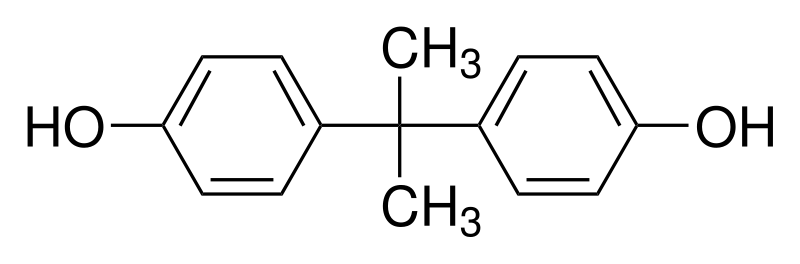
I was mostly interested in the chemical formerly used in producing plastics: BPA or bisphenol A.  There were five levels of concern in regards to exposure to this chemical as outlined by the National Toxicology Program, and frankly, the definitions were downright shocking and kind of nauseating.  "Reproductive toxicity in adult men and women and malformation is newborns" was defined as "Negligible Concern."  "Developmental toxicity for fetuses, infants, and children (effects on the mammary gland and early puberty in females, and productive toxicity in workers)" was defined as "Minimal Concern".  And "Developmental toxicity for fetuses, infants, and children (effects on the brain,  behavior, and prostate gland)" was classified as "Some Concern".  Very fortunately, many large companies such as Target, Wal-Mart, Costco, and REI have stopped selling products containing BPA and found safer substitutes that sell just as well.
This is a representation of the chemical structure of Bisphenol A.
Image found at viewzone.com

For further research on BPA, I went to these two websites: 
http://www.bisphenol-a.org/about/faq.html?gclid=CIzx3KT-9K8CFWQ0QgodCEP3RQ
http://www.fda.gov/newsevents/publichealthfocus/ucm064437.html

At the first website, I learned that BPA is used primarily to make polycarbonate plastic and epoxy resins.  The products made from BPA's byproducts are things such as electrical and electronic equipment (like CDs and DVDs), automobiles, sports safety equipment, reusable food and drink containers - products most of us use on a daily basis. This website declares that, and I quote, "the weight of scientific evidence clearly supports the safety of BPA and provides strong reassurance that there is no basis for human health concerns from exposure to BPA." 

Are these bottles safe for your child?  I don't know either.
Image found at diapersect.com
Thankfully, the second website shows that the FDA is not so convinced that BPA is not harmful.  In fact, the FDA recognizes potential effects of BPA on the brain, behavior, and prostate gland of fetuses, infants and children.  They also understand the uncertainties surrounding the current research of BPA effects on human health and have commissioned further research to be done on this topic.  The FDA has taken steps to support reducing human exposure to BPA, BUT the FDA is not recommending that families change the use of infant formula or foods, as the benefit of a stable source of good nutrition outweighs the potential risk of BPA exposure.  This recommendation is due to the aforementioned uncertainties regarding BPA research, but I don't believe families should follow such advice when their is such risk to their baby's health and other infant formulas not packaged in BPA-produced containers.

After reading this article, I firmly believe we should use the precautionary principle approach when regulating chemicals in the country.  It may cost more, but I believe human lives should be protected.

Wednesday, May 2, 2012

Unplugged for 24 hours

Or at least, as much as a college student realistically can be while still going to school.
m
All of my cords in their pre-unplugged phase.
photo taken by me

On Monday, for a period of 24 hours, I did not use my computer, cell phone, television, gameboy, cd player, electric fan, air conditioning, or any other electronic appliance for the sake of convenience or entertainment.  I unplugged appliances in my house that aren't used constantly like the toaster and crockpot.  I also unplugged my cell phone, laptop, and camera chargers and my heating pad.  I did very little driving: from home to school and back.  I didn't make any extra side trips.  And I used electric lighting as little as possible.

One thing I didn't unplug was my alarm clock.  There's only one clock in my house that isn't electronic, and it's not an alarm clock.  Due to the fact that I do have responsibilities (like school) and a clock is something that needs to be on at all times to be useful, I decided i was okay to leave it on.  Also, I did turn on my lamp when it got too dark to see in the house without it.

Most of these changes weren't so bad.  For example, unplugging the things I'm not constantly using wasn't so bad.  It's not so hard to plug a charger back in when you need the power.  And I can find other sources of entertainment when the electricity is off: namely books.  I read a lot normally, but after homework was done, I finished the entirety of short series in one sitting.  In the morning, I didn't use any lights at all and opened the curtains in every single room I went into.  Except, my bathroom has no windows and is pitch dark with the door shut, so I kind of needed light in there.
The tv I don't use much and could easily live without,
especially as compared to my laptop.
photo taken by me

The change I had biggest problems with was the no laptop.  It's not because I can't live without it or that I'm addicted to the internet.  There are several classes in which I take notes, and my linguistic anthropology class is one of them.  This is because I type faster than I write, and my anthro teacher talks really fast.  I really didn't like not being able to get down as much information in my notes.  Not to mention, I do a lot of homework on my laptop and often work at it at school.  So, not using / bringing my laptop with me to school isn't a change I'd be willing to continue.

The rest of the changes, simple as they are, I'm sure I wouldn't have trouble continuing (except maybe the crockpot and toaster thing because I don't live alone).  But in the little corner of the house I call my bedroom, I can minimize my energy use as much as possible.

The fan!!  One of several magical fans that
will lessen our use of the AC.
photo taken by me

One thing I want to mention really quick is that I learned it's almost impossible to escape using any kind of energy at all in our society when interacting with other people.  Even had I walked to school, the cafeteria and library always have on indoor lights, and teachers often use computers or overhead projectors for their classes.  There's no way I could stop all of that during my 24 hour period.  And even had I done this at home, I live with two other people.  Willing as they are to help me with my homework, my parents have responsibilities too - ones that often involve the use of electronically powered machines.

And now, last but not least: given unlimited time and money, what could I do to make my home more energy efficient?

1) Get energy efficient appliances
2) Solar panels on the roof
3) Convince my family to use our electrically powered fans instead of AC
4) Unplug more chargers and the like
5) Small individual AC units in rooms instead of the central one
6) Tear it all down and build a home similar to the Fronteir Project Building :D

Realistically, three and four are pretty much the only options I could actually accomplish due to lack of money and time.


Wednesday, April 18, 2012

Water, Water Everywhere!

Today, we’re going to witness a little battle: tap water vs. bottled water, and when it is over, I’ll tell you which one I think won.

So, my home’s tap water comes from the city’s municipal water supply.  That water comes from underground water (62%), from the Colorado River by way of Lake Matthews (32%), and from the State Project water in Northern California by way of the California Aqueduct (6%).  Before joining with the water supply from which we drink, the water is treated at two facilities: the Sierra Del Oro and Lester Water Treatment Plants or the Temescal Desalter.  Also, the water distribution system itself is treated with mono chloramines to clear away chemicals and such that might react with the organic matter in water to create disinfectant by-products.

Yes, it might be tasty, but we don't need
it.  Plus tap water might actually be better
for us.
Image from popsop.ru

Furthermore, many water samples are taken and tested for things like Uranium, Combined Radium, Arsenic, Lead, and Chromium.  In the most recent test done, 100% of the water samples were found free of harmful organisms and did not exceed any of the maximum contaminant levels as specified by the United States Environmental Protection Agency (USEPA) and California Department of Public Health (CDPH).  This means that tap water in Corona provided through the municipal water supply is very safe to drink.

The federal agency that monitors bottled water is the Food and Drug Administration (FDA).  Under the FDA, bottled water is regulated as a food.  As per regulations set by the FDA, bottled water are that it must be safe and that it be processed, bottled, held and transported under sanitary conditions.  The definition of bottled water is that the water is intended for human consumption and is sealed in bottles or other containers with no added ingredients except that it may contain safe and suitable antimicrobial agents.  However, fluoride also may be added within the limits set by the FDA.  Most of the regulations include the inspections that the bottled water and its manufacturing plants are subject to if the FDA decides to collect samples.  However, not all individual samples collected by the FDA are tested for all harmful contaminants, only suspected contaminants.  Furthermore, companies are not required to conduct such tests themselves to ensure the quality of their water.

On the other hand, the Environmental Protection Agency (EPA) is the federal agency that monitors tap water.  By my observations, their regulations are much stricter.  For one, there is a list of dozens of contaminants that must be tested for and taken out of water before it is allowed to be released into the municipal water supply.  The list includes categories such as microorganisms, disinfectants, disinfection byproducts, inorganic chemicals, organic chemicals, and radionuclides.  Cities are required to do tests every year and release an annual water report to share their findings.  They also monitor the sources from which the tap water comes from.

Next time you're thirsty, just make a quick trip to your
kitchen sink.
Image from santhoffplumbingco.com


In short, the EPA has stricter contaminant guidelines and watch the quality of tap water much more than the FDA and bottled water.  In fact, the FDA seems more concerned with the sanitation of packaging and transport when they should care about the quality of water just as much.

Beyond regulation, there are also many serious drawbacks to tap water itself.  For one, it costs a lot to buy, and the factories that make the bottles to hold the water produce a lot of pollution.  Then, you have to factor in all the resources used to transport the bottled water from one place to another.  One might think that recycling would help balance the effects on the environment, but 80% of all bottled water bottles end up in landfills.  And a good portion of those that are recycled are actually downcycled, turned into lesser quality plastic goods.

Whereas, tap water comes straight out of your sink, and all it costs in one more cup to clean.

So, who wins this little battle?

I’d say tap water hands down.

Wednesday, March 28, 2012

Pineapple Pizza Revealed

Today’s assignment was to pick a particular food we eat and research it.  I chose my favorite food, my dad’s homemade pineapple pizza.

The secret ingredient to make the best pizza ever.
Photo found at pictureshunt.com
There are four main ingredients in pineapple pizza: dough, sauce, cheese, and pineapple.  The dough is made from scratch.  It is flour-based, and my dad uses quick-rise yeast so we can have pizza in one day instead of two.  The sauce he uses is Ragu pizza sauce which is made out of tomato puree (water, tomato paste), soybean oil, salt, spices, and natural flavor.  They do not list exactly what spices are used or what the natural flavors are.  The last two ingredients: cheese and pineapple, are pretty self-explanatory.

The Ragu pizza sauce was made with California tomatoes.  The Gold Medal flour comes from wheat made in America.  Gold Medal buys the wheat for their flower from family farms across the nation, but it has to be from a clean crop to make it past their inspection.    The cheese, from the Precious brand, was made somewhere in the US.  The website only mentions that the company is based in New York, but 50% of the packaging is made from plant-based renewable resources.  The Dole Pineapple was grown and packaged in Hawaii.  At the Dole Plantation, all pineapples are planted by hand and are watered with irrigation.  There are no mentioned pesticides or hormones mentioned.  Natural is considered the best way to raise them

The only ingredient in my pizza that is sure to have come
from California.
Photo found at amazon.com
So, all the ingredients come from larger manufacturers, but Gold Medal and Ragu purchase their ingredients from smaller farm businesses.  In the case of Dole and Precious, it is mostly the large corporations themselves who benefit economically.  This probably hurts smaller farm businesses and many local farmer’s market.  On the other hand, Gold Medal and Ragu sales economically benefit both themselves and the smaller farms they purchase from, because the more they sell, the more they can buy locally.

The environmental impacts of the ingredients of my single pineapple pizza by itself isn’t too bad, but added up, the total becomes a lot.  The can of pineapple, part of a much larger shipment, would have to get to the mainland either by ship or plane.  The cheese could have come from any of the 50 states in America, and the same is true of the wheat for the flour.  The only ingredients that absolutely wouldn’t have had to travel far are the tomatoes from the Ragu pizza sauce since those were grown from California.  Together, that would add up to a lot of fuel being used, which means more green house gas emissions and more drilling for oil. 

However, there are a few saving graces to some of these products.  The Ragu jar and Gold Medal flour package, once emptied and cleaned out, could be recycled.  And as aforementioned, Precious makes its packaging out of 50% renewable plant-based products.  Although not perfect set ups, they are steps in the right direction.

There is at least one serving from each level of the
food pyramid on the pizza.
Photo found at nal.usda.gov
As far as pizza goes, homemade pineapple pizza is fairly healthy.  My dad makes it with a thin crust, so you don’t consume huge amounts of starch.  He puts on enough pineapple chunks to equal two servings fruit for a day.  Cheese, a dairy product, is also good for you as long as you don’t eat too much of it.  And there’s none of that grease on the pizza that restaurants like to glob on.  The only thing that’s kind of iffy is the sauce, because it’s base is tomato paste, because the further something gets from it’s original state, the less nutritious it is.  However, it’s not exactly bad for you either.  The pizza sauce as only 2% of your daily fat intake and 10% of your daily sodium intake, but it also as 6% Vitamin A and 2% Vitamin C and Iron per serving size.

Sources Used:
Ragu.com
Goldmedalflour.com
Dole-plantation.com
Preciouscheese.com

Wednesday, March 21, 2012

Hypothetical RCC Sustainability Assessment

This week, the assignment was to consider how we would assess the sustainability of our school.  If I were going to assess how green our campus, I would consider the following factors.

Exactly how efficient is our bus system?
Photo found at thebergernetwork.com

1) Whether the school uses any energy efficient appliances
2) How many recycling receptacles the campus has and how much the students actually use them
3) How efficient the available public transportation to and from the school is
4) How much or little trash the school produces
5) Where the cafeteria and vending machine food comes from and how it gets to the school
6) The ratio of students to physical size of college to amount of actual use of the area
7) Whether the college uses any forms of renewable energy
8) Whether the school prints everything on paper or makes effort to issue information electronically
            -How well is the school website designed and how much is it used?
            -What efforts do individual teachers make to cut down on paper consumption?
9) How much green house gas emissions our school produces

Other schools have already been assessed for their sustainability.  One such school is Berkshire School in Sheffield, Massachusetts.  Their sustainability is measured by the Sustainability, Tracking, Assessment, and Rating Systems (STARS) that was developed by the Association for Advancement of Sustainability in Higher Education.  Berkshire School is rated annually, and as of January of 2012, Berkshire School attained silver status.  This might sound good, but silver is fourth highest out of five ranks that STARS provides.  However, it does mean that Berkshire School has done quite a lot to go green.
The conceptual model for sustainability used at Berkshire School.
Photo found at berkshireschool.org

In their effort to become green, Berkshire School considers three things environmental integrity, economic justice, and social equity.  The school has a Director of Sustainability and a sustainability committee that are tasked with establishing guidelines through which the school can become more sustainable.  The committee pursues this within five general categories.

1)    Education/Administration in which the goal is to promote education, research, and awareness of social, economic, and environmental sustainability for both the staff and students.
2)    Energy in which their eventual goal is to create a net zero Green House Gas emissions for both the campus and student living areas.
3)    Food in which they want to create a local and organic food system that produces as little waste as possible
4)    Land use in which the goal is to protect and preserve the natural environment and nature of the campus.
5)    Procurement/Disposal in which they want to produce the most efficient way of procuring and disposing of campus necessities and supplies.

If I were going to devise a plan for assessing an area of our school, I would try to assess the sustainability of our food supply.  Due to the fact that the vast majority of the food available for purchase is prepackaged and frozen, I think the sustainability level is very low. 

Of course the first step in would be to gain permission to assess the sustainability of our food resources.  I would prepare a presentation as to why the assessment would be a good idea and help benefit student life on campus and then contact the President of Riverside Community College, Dr. Cynthia Azari for permission.  The presentation would mention things such as there are some government incentives for sustainability and many organizations will donate to aid the process of sustainability.

Once I had permission, I would search for volunteers to help carry out the assessment.  That way, the project would be much less costly, another incentive for the powers that be to approve the assessment.  There is a sustainability club at the college who would probably be willing to help.  I would also contact the president of Alpha Gamma Sigma to see if any of the members would be interested in obtaining volunteer service hours by aiding in this project.

Although not a pretty sight, this is generally what eventually
happens to our leftover food.
Photo found at novaksanitary.com

Next, I would conduct some preliminary research.  I would arrange an interview with Cheryl Ruzak, the Director of Food Services, to find out things like how much food is ordered per week, where it comes from, how much it costs, how much of each thing is ordered, how much of each thing is sold, and how much waste the cafeteria produces on a weekly basis by themselves for things such as preparation of food.  If she could not answer some of those questions, I would enlist the volunteers to help in a field experiment to obtain said answers.

Once I know how much food is ordered, I would measure it against how much is purchased.  I would also measure how much trash is produced by the cafeteria against how much is produced by the students.  Once I know where the food comes from, I would research the path it took as far back as I could (to the very original supplier if I could) and generate an estimate of the environmental effects.  And if  by some miracle I had enough volunteers willing to dig through and separate trash, I would also want to do an evaluation of how much of food purchased from the cafeteria is actually consumed.  Because I have seen people buy a chicken finger meal and then throw half of it away.


Wednesday, March 7, 2012

Daily Resource Use

This week, the assignment for environmental science class was to carry around a notebook and take note of all the "earth's resources" we use in a 24-hour period and place them into various categories.  Since either directly or indirectly everything we use comes from some resource found in nature, I just wrote down everything I used.  After all, we can't create something from nothing.  My 24-hour period started at 6PM Tuesday night and ended 6PM Wednesday night.

I went to McDonalds for lunch.
Photo from moreinterestingfacts.com

These were the assigned categories:
A) Food and drink
-Glass of milk
-1 egg
-2 slices of toast
-Toaster
-1 slice of ham
-Plate
-Refrigerator
-Water (in a bottle)
-2 cups of soda (with ice)
-2 straws/lid
-2 burgers (in paper wrapper)
-Fries (in carton)
-2 chicken sandwiches (in plastic wrapper)
-5 chicken nuggets (in carton)
B) Housing and other buildings
-My house
-2 classrooms at school
-The library at school
-2 fastfood restaurants
C) Transportation and roads  
-Car
-Gasoline
-Keys 
-My legs
-Street
-Sidewalk
-Elevator
D) Clothing
-T-shirt
-Pants
-Socks
-Undergarments
-Sweatshirt
-Pajamas
-Shoes
-Jeans
-Shirt
E) School supplies  
-Laptop
-Library computer
-Textbooks
-Notebook
-Paper
I have a MacBook laptop.
Photo from amazon.com

-Pen
-Pencil 
-Printer
-Printer paper
-Chair
-Desk
-Backpack
-My hands
F) Personal care products
 -Toilet
-Toilet paper
-Sink
-Soap
-Towel
-Shower
-Shampoo 
-Toothbrush
-Toothpaste
-Hairbrush
-Band-aid
-Neosporin
G) Leisure activities
 -Television
-Laptop 
-Novels
-Comic books
-Notebook
-Pen
H) Other
-Lights
-Bed
-Pillows
-Comforter/sheets
-Cat/dog food
-Cat/dog dishes
-Contacts
-Glasses
-Cell phone
-Sunglasses
-Table
-Loveseat
-My body in general
-Air

A Generic Band-Aid
Photo from marthafry.org

The next step was to research in depth about one of the items on the list.  I chose band-aids.  Band-aids are generally made from gauze, glue, and something known as ETS fabric.  Band-aids are used in basic first aid to stop a cut from bleeding to the point where the band-aid can be safely removed to allow the wound to scab over.  Band-aids are manufactured as a mass-produced product in factories, and a single role of ETS fabric can produce 300,000 - 1.8 million band-aids depending on the size of the band-aid.

Due to the nature of the components, band-aids cannot be recycled and therefore are disposed of in trash cans where they are then sent to landfills.  A single band-aid factory can produce over 4 billion band-aids a year, and if every single one of the band-aids are used and thrown away, that would take up a lot of room.  Let's say ten band-aids tacked together is 2 cm tall and the average band-aid size is 2 cm by 8 cm.  Those 4 billion band-aids would take up 12.8 billion cubed centimeters, roughly 79,000 cubed miles.  That's a lot of space to take up.  Luckly, band-aids can be incinerated.  Unfortunately, their ashes will also take up space.

Before band-aids were invented in the early 1900s, people generally used bandages.  And assuming they were washed thoroughly enough, they were reusable.  This might have been a more environmentally friendly option.

Nothing genuinely surprised me about this assignment.  I always knew I used a lot of the Earth's resources daily, especially since learning my lifestyle would take over 4 Earths to support if everyone lived like me.  It just made me more aware of the sheer number of things I use in a single day.  However, I did learn that there are many things I use but take for granted and don't consider them as things I use.  For example, the sidewalk has always been present where I live, go to school, and many other places, but until today, I didn't think about how it's one of the things I use to get from point A to point B.  Without the sidewalk, I'd be walking on something like grass or dirt. 

Something I can do to be environmentally friendly is to eat out less.  Today just happened to be one of those few day I ate out for lunch and dinner.  However, eating out less period would produce less waste and use less gas.  Also, I started pouring leftover ice out in the planters rather than just dumping it down the sink.  Once it has melted, that will be a more productive use of the water.


Monday, February 20, 2012

My Ecological Footprint

How big is your ecological footprint?
Picture found at http://graciousinlove.files.wordpress.com/
Today, I visited footprintnetwork.org/calculator to calculate my ecological footprint.  An ecological footprint tells you how many planet Earths it would take to provide everyone on the planet with the lifestyle you live.  The average human lifestyle takes anywhere from 3-5 Earths.  If everyone on the planet lived like me, it would take 4.5 Earths.

The calculations begin with your food consumption.  I eat pork once every few weeks, about twice a month.  I eat beef once a week and fish once a month.  Poultry is something I eat almost everyday, upwards of four to five times a week.  Eggs, milk, and dairy products are consumed nearly every meal.  About half of my diet is based of fresh, unpackaged foods, however very little of the food I eat is locally grown.  My father has a vegetable garden, but that only accounts for about 10% of our food.  We have three avocado trees, various other fruit trees, three tomato plants, and a few other producers thus far.

The second part of the calculations involve clothes, furniture, and things for your home.  I don’t buy any news clothes on monthly.  I use old clothes until they wear out and just wash them frequently.  So, my shirts, pants, shoes, etc last years.  Most of our furniture is secondhand, made by my dad, or was bought before we moved into this house.  We keep furniture until we absolutely need to replace them.  The same goes for electronic appliances.  When something breaks, we try to fix it or make due the best we can.  We only replace them when they can no longer be repaired.  My current bed is my grandmother’s old one, and the couch in our living room was given to us by a neighbor. 

Recycling is good for the earth.
Photograph found at prlog.org

Also, we rarely buy new electronic products, maybe once a year at Christmas time.  The television we got recently was a hand me down from my mother’s work place.  In my family, cell phones are used until broken and irreparable.  Occasionally, we buy new books and magazines for the house.  We have a monthly magazine subscription.  We get three magazines and a newspaper secondhand from my grandpa.  Lately, the only books I buy are school textbooks.  For everything else, I go to the local library.

The next part of the calculations involved recycling.  In my house, we recycle all our paper waste but rarely buy recycled paper products.  Although, a few of my school notebook are made of recycled paper.  We also recycle 90% of our plastic waste but don’t specifically buy PCR recycled products.  Anytime we purchase those are purely coincidence.

The next part of the calculations involve the house itself.  I live in a free-standing house with two other people, and the main materials the house is made from are wood, brick, and stucco.  The walls and roof are wood.  We have two brick columns in front of the house, and the ceiling and outside walls are made of stucco.  My house has running water and working electricity.  None of our electricity is from a renewable power source; it all comes from the electric company Southern California Edison.  We spend $75 on electricity and $25 on gas per month.

The last part of the calculations had to do with traveling.  I travel approximately 70 miles per week in my car, and I almost never drive with others.  Most of my traveling is to go to and from school, and I do that on my own.  My car is a 2006 Toyota Sienna, and it gets 17 miles to the gallon in the city and 24 miles to the gallon highway.  Combined, it has a 19 MPG rating.  As for other modes of transportation, I never ride on motorcycles of any kind, I almost never use public transportation like a bus or train, and I haven’t flown anywhere in years.

The breakdown of my ecological footprint.
Screencap taken from footprintnetwork.org/calculator

At the end of all these calculations, we would need 4.5 planet Earths if every one of the seven billion people on the planet lived like me.  The largest area of my ecological footprint, at 44%, is of services.  21% goes to Food, 15% is Goods, 12% is shelter, and 8% is Mobility.  To support my lifestyle, it takes 20.1 global acres and 19.8 tons of carbon dioxide.

If I reduced the amount of animal products I eat by half, purchased products that used less packaging or were made from recycled consumer products, installed solar panels in my home, used more energy-efficient appliances, and used public transportation one day a week instead of driving my car, it would reduce my ecological footprint by an entire earth.  If every American did this, we would use almost 2 billion less global acres to sustain our lifestyles.  That area would be equivalent to approximately 1.5 billion footall fields.

The newest square-foot gardening plots in my dad's garden.
Photo taken by me


As much as I would love to be able to reduce my ecological footprint in such a way, it’s not entirely doable.  My family doesn’t have the money to buy brand new energy-efficient appliances or install solar panels on our roof.  And I highly doubt I’ll be eating half the amount of animal products I do now.  I like meat and milk way too much, and like everyone else, I can be a selfish person.  However once I transfer to Cal State Fullerton, I’ll be taking the train to school rather than driving, and I can start car-pooling more often.  I can also pay more attention to buying recycled consumer product.  Also, my dad hopes soon that his garden will be providing at least one quarter of our food.