Wednesday, March 28, 2012

Pineapple Pizza Revealed

Today’s assignment was to pick a particular food we eat and research it.  I chose my favorite food, my dad’s homemade pineapple pizza.

The secret ingredient to make the best pizza ever.
Photo found at pictureshunt.com
There are four main ingredients in pineapple pizza: dough, sauce, cheese, and pineapple.  The dough is made from scratch.  It is flour-based, and my dad uses quick-rise yeast so we can have pizza in one day instead of two.  The sauce he uses is Ragu pizza sauce which is made out of tomato puree (water, tomato paste), soybean oil, salt, spices, and natural flavor.  They do not list exactly what spices are used or what the natural flavors are.  The last two ingredients: cheese and pineapple, are pretty self-explanatory.

The Ragu pizza sauce was made with California tomatoes.  The Gold Medal flour comes from wheat made in America.  Gold Medal buys the wheat for their flower from family farms across the nation, but it has to be from a clean crop to make it past their inspection.    The cheese, from the Precious brand, was made somewhere in the US.  The website only mentions that the company is based in New York, but 50% of the packaging is made from plant-based renewable resources.  The Dole Pineapple was grown and packaged in Hawaii.  At the Dole Plantation, all pineapples are planted by hand and are watered with irrigation.  There are no mentioned pesticides or hormones mentioned.  Natural is considered the best way to raise them
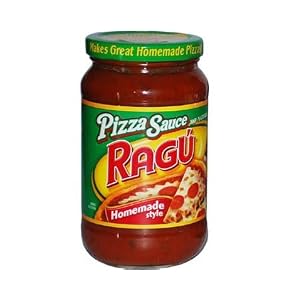
The only ingredient in my pizza that is sure to have come
from California.
Photo found at amazon.com
So, all the ingredients come from larger manufacturers, but Gold Medal and Ragu purchase their ingredients from smaller farm businesses.  In the case of Dole and Precious, it is mostly the large corporations themselves who benefit economically.  This probably hurts smaller farm businesses and many local farmer’s market.  On the other hand, Gold Medal and Ragu sales economically benefit both themselves and the smaller farms they purchase from, because the more they sell, the more they can buy locally.

The environmental impacts of the ingredients of my single pineapple pizza by itself isn’t too bad, but added up, the total becomes a lot.  The can of pineapple, part of a much larger shipment, would have to get to the mainland either by ship or plane.  The cheese could have come from any of the 50 states in America, and the same is true of the wheat for the flour.  The only ingredients that absolutely wouldn’t have had to travel far are the tomatoes from the Ragu pizza sauce since those were grown from California.  Together, that would add up to a lot of fuel being used, which means more green house gas emissions and more drilling for oil. 

However, there are a few saving graces to some of these products.  The Ragu jar and Gold Medal flour package, once emptied and cleaned out, could be recycled.  And as aforementioned, Precious makes its packaging out of 50% renewable plant-based products.  Although not perfect set ups, they are steps in the right direction.

There is at least one serving from each level of the
food pyramid on the pizza.
Photo found at nal.usda.gov
As far as pizza goes, homemade pineapple pizza is fairly healthy.  My dad makes it with a thin crust, so you don’t consume huge amounts of starch.  He puts on enough pineapple chunks to equal two servings fruit for a day.  Cheese, a dairy product, is also good for you as long as you don’t eat too much of it.  And there’s none of that grease on the pizza that restaurants like to glob on.  The only thing that’s kind of iffy is the sauce, because it’s base is tomato paste, because the further something gets from it’s original state, the less nutritious it is.  However, it’s not exactly bad for you either.  The pizza sauce as only 2% of your daily fat intake and 10% of your daily sodium intake, but it also as 6% Vitamin A and 2% Vitamin C and Iron per serving size.

Sources Used:
Ragu.com
Goldmedalflour.com
Dole-plantation.com
Preciouscheese.com

Wednesday, March 21, 2012

Hypothetical RCC Sustainability Assessment

This week, the assignment was to consider how we would assess the sustainability of our school.  If I were going to assess how green our campus, I would consider the following factors.

Exactly how efficient is our bus system?
Photo found at thebergernetwork.com

1) Whether the school uses any energy efficient appliances
2) How many recycling receptacles the campus has and how much the students actually use them
3) How efficient the available public transportation to and from the school is
4) How much or little trash the school produces
5) Where the cafeteria and vending machine food comes from and how it gets to the school
6) The ratio of students to physical size of college to amount of actual use of the area
7) Whether the college uses any forms of renewable energy
8) Whether the school prints everything on paper or makes effort to issue information electronically
            -How well is the school website designed and how much is it used?
            -What efforts do individual teachers make to cut down on paper consumption?
9) How much green house gas emissions our school produces

Other schools have already been assessed for their sustainability.  One such school is Berkshire School in Sheffield, Massachusetts.  Their sustainability is measured by the Sustainability, Tracking, Assessment, and Rating Systems (STARS) that was developed by the Association for Advancement of Sustainability in Higher Education.  Berkshire School is rated annually, and as of January of 2012, Berkshire School attained silver status.  This might sound good, but silver is fourth highest out of five ranks that STARS provides.  However, it does mean that Berkshire School has done quite a lot to go green.
The conceptual model for sustainability used at Berkshire School.
Photo found at berkshireschool.org

In their effort to become green, Berkshire School considers three things environmental integrity, economic justice, and social equity.  The school has a Director of Sustainability and a sustainability committee that are tasked with establishing guidelines through which the school can become more sustainable.  The committee pursues this within five general categories.

1)    Education/Administration in which the goal is to promote education, research, and awareness of social, economic, and environmental sustainability for both the staff and students.
2)    Energy in which their eventual goal is to create a net zero Green House Gas emissions for both the campus and student living areas.
3)    Food in which they want to create a local and organic food system that produces as little waste as possible
4)    Land use in which the goal is to protect and preserve the natural environment and nature of the campus.
5)    Procurement/Disposal in which they want to produce the most efficient way of procuring and disposing of campus necessities and supplies.

If I were going to devise a plan for assessing an area of our school, I would try to assess the sustainability of our food supply.  Due to the fact that the vast majority of the food available for purchase is prepackaged and frozen, I think the sustainability level is very low. 

Of course the first step in would be to gain permission to assess the sustainability of our food resources.  I would prepare a presentation as to why the assessment would be a good idea and help benefit student life on campus and then contact the President of Riverside Community College, Dr. Cynthia Azari for permission.  The presentation would mention things such as there are some government incentives for sustainability and many organizations will donate to aid the process of sustainability.

Once I had permission, I would search for volunteers to help carry out the assessment.  That way, the project would be much less costly, another incentive for the powers that be to approve the assessment.  There is a sustainability club at the college who would probably be willing to help.  I would also contact the president of Alpha Gamma Sigma to see if any of the members would be interested in obtaining volunteer service hours by aiding in this project.

Although not a pretty sight, this is generally what eventually
happens to our leftover food.
Photo found at novaksanitary.com

Next, I would conduct some preliminary research.  I would arrange an interview with Cheryl Ruzak, the Director of Food Services, to find out things like how much food is ordered per week, where it comes from, how much it costs, how much of each thing is ordered, how much of each thing is sold, and how much waste the cafeteria produces on a weekly basis by themselves for things such as preparation of food.  If she could not answer some of those questions, I would enlist the volunteers to help in a field experiment to obtain said answers.

Once I know how much food is ordered, I would measure it against how much is purchased.  I would also measure how much trash is produced by the cafeteria against how much is produced by the students.  Once I know where the food comes from, I would research the path it took as far back as I could (to the very original supplier if I could) and generate an estimate of the environmental effects.  And if  by some miracle I had enough volunteers willing to dig through and separate trash, I would also want to do an evaluation of how much of food purchased from the cafeteria is actually consumed.  Because I have seen people buy a chicken finger meal and then throw half of it away.


Wednesday, March 7, 2012

Daily Resource Use

This week, the assignment for environmental science class was to carry around a notebook and take note of all the "earth's resources" we use in a 24-hour period and place them into various categories.  Since either directly or indirectly everything we use comes from some resource found in nature, I just wrote down everything I used.  After all, we can't create something from nothing.  My 24-hour period started at 6PM Tuesday night and ended 6PM Wednesday night.

I went to McDonalds for lunch.
Photo from moreinterestingfacts.com

These were the assigned categories:
A) Food and drink
-Glass of milk
-1 egg
-2 slices of toast
-Toaster
-1 slice of ham
-Plate
-Refrigerator
-Water (in a bottle)
-2 cups of soda (with ice)
-2 straws/lid
-2 burgers (in paper wrapper)
-Fries (in carton)
-2 chicken sandwiches (in plastic wrapper)
-5 chicken nuggets (in carton)
B) Housing and other buildings
-My house
-2 classrooms at school
-The library at school
-2 fastfood restaurants
C) Transportation and roads  
-Car
-Gasoline
-Keys 
-My legs
-Street
-Sidewalk
-Elevator
D) Clothing
-T-shirt
-Pants
-Socks
-Undergarments
-Sweatshirt
-Pajamas
-Shoes
-Jeans
-Shirt
E) School supplies  
-Laptop
-Library computer
-Textbooks
-Notebook
-Paper
I have a MacBook laptop.
Photo from amazon.com

-Pen
-Pencil 
-Printer
-Printer paper
-Chair
-Desk
-Backpack
-My hands
F) Personal care products
 -Toilet
-Toilet paper
-Sink
-Soap
-Towel
-Shower
-Shampoo 
-Toothbrush
-Toothpaste
-Hairbrush
-Band-aid
-Neosporin
G) Leisure activities
 -Television
-Laptop 
-Novels
-Comic books
-Notebook
-Pen
H) Other
-Lights
-Bed
-Pillows
-Comforter/sheets
-Cat/dog food
-Cat/dog dishes
-Contacts
-Glasses
-Cell phone
-Sunglasses
-Table
-Loveseat
-My body in general
-Air

A Generic Band-Aid
Photo from marthafry.org

The next step was to research in depth about one of the items on the list.  I chose band-aids.  Band-aids are generally made from gauze, glue, and something known as ETS fabric.  Band-aids are used in basic first aid to stop a cut from bleeding to the point where the band-aid can be safely removed to allow the wound to scab over.  Band-aids are manufactured as a mass-produced product in factories, and a single role of ETS fabric can produce 300,000 - 1.8 million band-aids depending on the size of the band-aid.

Due to the nature of the components, band-aids cannot be recycled and therefore are disposed of in trash cans where they are then sent to landfills.  A single band-aid factory can produce over 4 billion band-aids a year, and if every single one of the band-aids are used and thrown away, that would take up a lot of room.  Let's say ten band-aids tacked together is 2 cm tall and the average band-aid size is 2 cm by 8 cm.  Those 4 billion band-aids would take up 12.8 billion cubed centimeters, roughly 79,000 cubed miles.  That's a lot of space to take up.  Luckly, band-aids can be incinerated.  Unfortunately, their ashes will also take up space.

Before band-aids were invented in the early 1900s, people generally used bandages.  And assuming they were washed thoroughly enough, they were reusable.  This might have been a more environmentally friendly option.

Nothing genuinely surprised me about this assignment.  I always knew I used a lot of the Earth's resources daily, especially since learning my lifestyle would take over 4 Earths to support if everyone lived like me.  It just made me more aware of the sheer number of things I use in a single day.  However, I did learn that there are many things I use but take for granted and don't consider them as things I use.  For example, the sidewalk has always been present where I live, go to school, and many other places, but until today, I didn't think about how it's one of the things I use to get from point A to point B.  Without the sidewalk, I'd be walking on something like grass or dirt. 

Something I can do to be environmentally friendly is to eat out less.  Today just happened to be one of those few day I ate out for lunch and dinner.  However, eating out less period would produce less waste and use less gas.  Also, I started pouring leftover ice out in the planters rather than just dumping it down the sink.  Once it has melted, that will be a more productive use of the water.